Whether it is Star Wars, Star Trek, or Avatar, most of us have been exposed to some representation of an alien language. Something that these franchises share in common is that their aliens are humanoid: they all have physical and/or psychological features that resemble humans. I believe aliens are often personified because, on the one hand, it is easier to design creatures using concepts that are familiar to our experience and, on the other hand, the audience will relate more to aliens that experience the world more similarly to us than, let’s say, a bacteria-looking alien.1 From a narrative standpoint, aliens are more interesting characters the more they can interact with us in fundamentally the same ways that we interact with other humans or other animals. So, if an alien can play a human role (as in the movies listed above), or a pet role (as in Lilo & Stich) they fit well with our experience and result in more engaging stories. It shouldn’t be surprising then that language has come up again and again as a primary feature of alien representations; since language is at the core of humanity, its existence is almost a prerequisite for the alien to be a character of our story.
I don’t think there is anything wrong with personifying aliens for narrative or production purposes and, in fact, there is no inherent reason why aliens couldn’t be similar to us.2 What I regret is the lack of alien representations that aim to challenge what feels familiar to us. After all, authors incorporate aliens in their stories because they want to bring the element of surprise; they want to evoque that feeling of awe that the unknown produces; they want to take advantage of those qualities that make aliens distinct from us.
When it comes to representing alien communication, movies and books have a long history of either ignoring the topic or personifying alien communication as much as the aliens themselves. Authors can ignore the topic because they are not familiar with it, because it is too much work, or simply because it is not relevant to the story and its inclusion could result distracting; whatever the reason, science fiction has come up with a few ways to justify the exclusion of alien communication: either there is an intergalactic automatic translation device, or a magical pill that helps humans acquire ACSs, or telepathy, or the aliens learn our language, or you-name-it. The fact that such explanations are commonly used shows that the topic is important even when it is deliberately avoided.3

Examples of personified alien communication include Huttese, Klingon, and Na’vi. Huttese is the pseudo-language spoken by the Hutts in Star Wars; like other alien languages in the movie series, it is a representation inspired in a human language but absent of descriptive meaning or grammar.4 In contrast, both Klingon and Na’vi are constructed languages (abbreviated conlangs) which were designed by linguists (Marc Okrand and Paul Frommer, respectively) to provide the Klingon and the Na’vi humanoid aliens with the lexical richness and structural properties characteristic of human language. To make their conlangs more alienly convincing, the designers played with atypical language features (or what felt atypical to them): Klingon has an object-verb-subject word order and an unnaturalistic distribution of sounds5; and Na’vi features ejective consonants, which are nonexistent in major European languages, and infixes for verbal inflection. Interestingly, as far as I know these languages don’t have any feature that is unnatural per se; instead, their alienness relies on the uncommon array of linguistic choices made by their creator and, specially, on the audience’s expectations. Since both conlangs were designed for a western audience familiar with a handful of languages (i.e., romance and germanic languages), any language feature that is uncommon to these languages becomes exotic enough to feel alien.6 Since these conlangs are spoken by humanoid aliens who may share the anatomy of our vocal tracts, it makes sense to give them languages analogous to ours and it facilitates their acquisition by humans (both from a narrative and a production perspective) which also favors the formation of a fanbase. In other words, personified alien languages have both linguistic and commercial appeal. However, as far as breaking the nature of human language to step into the unknown—arguably an unnecessary and expensive endeavor for a language commissioned for a film—these conlangs fall short on expectations.

What science fiction has traditionally missed when it comes to alien communication is that, once you think outside —or try your best to think outside— of the human box, you can challenge the way you think about language, which in return provides you (the author and the reader) with an excuse to imagine fascinating scenarios where communication plays a central role.
Luckily for us some people have accepted this challenge. Works that have explored alien communication metalinguistically (i.e., that talk about the ACS without implementing it) include Stanisław Lem’s Solaris (1961), John Brunner’s Total Eclipse (1974), Carl Sagan’s Contact (1985), Ted Chiang’s The Story of your Life (1998), China Mieville’s Embassytown (2011), and Andy Weir’s Project Hail Mary (2021), to mention some examples. These books (and the movies that have been inspired by some of them) have in common that they move away from a linguistic system that resembles human language. For instance, the aliens in The Story of your Life speak a language that violates the characteristic linearity (processing words in a sequential order) of human language; the aliens in Contact use numbers and arithmetic relations to encode instructions to humans; and the ocean-like alien in Solaris poses such a large linguistic challenge to the human characters that—spoiler alert— they end up giving up their mission to decode it. All of these stories do a great job at weaving the theme of alien communication in their narratives from inventive angles… but they avoid illustrating how these ideas unfold in practice. At best, these stories give only a taste of what the ACS is like, which frankly is already more than enough linguistic detail for sci-fi stories that are not concerned on the language itself but on the implications that understanding (or not) such a language has for humanity.
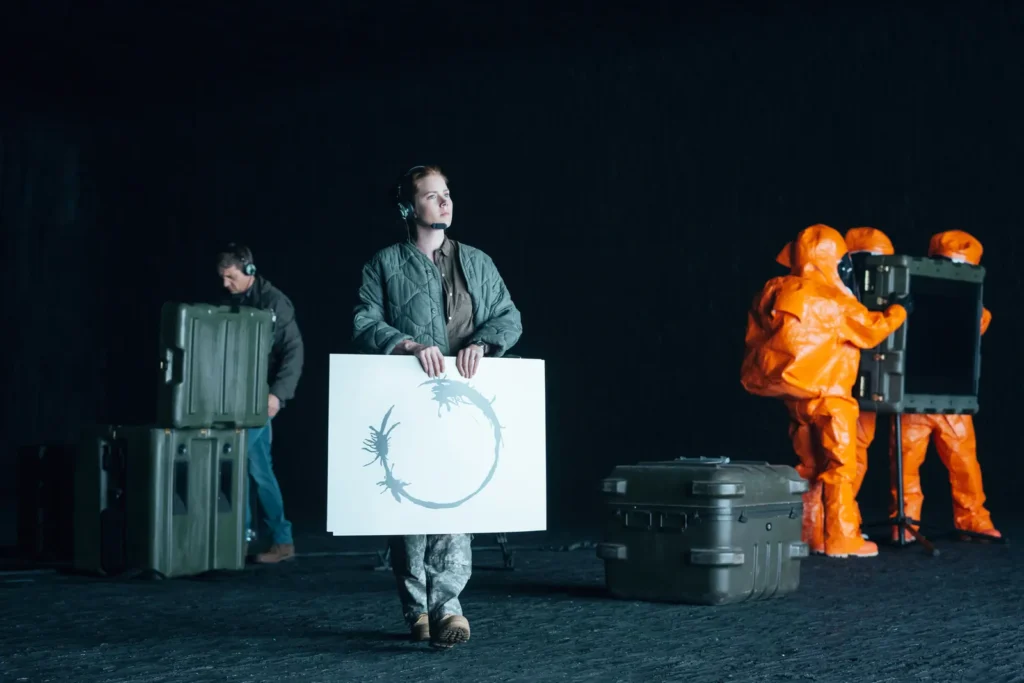
To my knowledge, there is no sci-fi work that offers both a detailed exploration and an implementation of an ACS. Such a work would likely look more like a thesis in (xeno)linguistics than a sci-fi novel. However, I can conceive of a story that incorporates a fully fleshed out ACS whose technicalitiescan be explained outside of the story in a similar fashion that Tolkien wrote The Lord of the Rings to provide a home to his conlangs. Within science fiction one remarkable example is Native Tongue (1984) by linguist and author Suzette Haden Elgin, who also developed the feminist conlang Láadan, featured in the story. While Láadan is not an ACS, Native Tongue is a good example of how implementing a communication system rather than just describing it can result in a powerful narrative: first, similarly to Klingon or Na’vi, the reader is encouraged to dig deeper into the background of the story through its language (or whichever communication system its characters use) and to join a community of speakers; second, providing a materialized example is more of a convincing argument than merely claiming facts about the alien nature of the communication; finally, and most importantly, the reader is welcomed to evaluate how effective is the conlang or constructed ACS in doing whatever it’s supposed to do.
In conclusion, science fiction works have traditionally overlooked communication as a theme despite it being central to narratives involving interactions with aliens. Not every story will benefit from a careful discussion on the nature of intergalactical communication and not every story should conceptualize ACSs as something entirely different from humans—as mentioned above, personified ACSs are interesting too and have their own advantages. However, exploring the theme opens many creative doors within a genre that has historically been concerned with being scientifically convincing (even when the science is not sound) but has often ignored the science of language.
- Besides, before the advent of CGI, hiring human actors was probably the most convenient way to represent aliens, and I suspect that this production convenience still plays an important role. ↩︎
- Some science fiction authors justify this resemblance as a result of convergent evolution, an argument that I consider very egotistical though not necessarily wrong. ↩︎
- It would be really cool to read a novel or watch a movie that explores how any of these magical solutions work! ↩︎
- Star Wars’ sound designer Ben Burtt devised Huttese inspired on Quechua. www.starwars.com/news/jedi-at-40-ben-burtt-randy-thom? ↩︎
- OVS languages account for 11 out of 1376 languages surveyed in the World Atlas of Language Structures (WALS): wals.info/feature/81A#2/18.0/153.1 ↩︎
- As I was reading about these pseudolanguages and conlangs I found interesting that all the creators used “exotic” languages to inspire to some extent their representation of an alien language. I believe they did so with the best of artistic and linguistic intentions but I found problematic the idea of using minority languages to represent our idea of what could be alien. Imagine being a speaker of Quechua watching Star Wars and listening to one character (who happens to be a crime lord) speak a language that deliberately resembles your native tongue. This might be a great study case for how western (and particularly English) bias in linguistics influences how we think of minority languages… ↩︎