An introduction to Trilakese
Far in the future, a group of explorers arrives at a planet inhabited by aliens that resemble trees: Trilaks. They soon discover that Trilaks have an alien communication system (ACS) called Trilakese; some researchers argue that this ACS—more than a simple system—is a fully fledged alien language!
This part of the Trilak Project is a description of such alien language. It is not a grammar in the classical sense of the word because Trilakese is not a language in the classical sense, not even within sci-fi standards.
Trilakese is special in a few ways, such as:
- It is not a spoken language; it is not a signed language; it is not a written language. Trilakese is a branched language. Meaning is not encoded in sounds, or in hand shapes, or in graphemes or logograms; meaning in Trilakese is encoded in the complex structures that branches make.
- Trilakese violates some structural characteristics of human language: It is not linear—a Trilak can speak multiple utterances in parallel. Trilakese lacks negation; it lacks question words; it doesn’t have thematic roles.
- Trilakese is not categorical. Most content words in human languages are categories (e.g., the word dog is a category that groups all instances of what we understand qualifies as a dog). Trilakese is fluid. Nouns in Trilakese fall into a continuum of meaning in which closer points correspond to closer meanings.
- Trilakese is absurd… at least for us. It expresses things in ways that are very impractical for humans, but make sense for Trilaks.
Despite these unnatural attributes, Trilakese preserves some properties which are often associated with language. For instance:
- Trilakese is a complex communication system: it is difficult to decipher; it cannot be explained in a few words.
- It is systematic: there is a grammar to it.
- It is productive: it can express an infinite number of utterances from a finite number of patterns.
- It has displacement: it can express events outside of the here-and-now such as events from the past and imaginary events.
- It serves different purposes. In a similar fashion that human language does not only transmit information but also serves social and cognitive functions, Trilakese has a social function—more about this later.
To understand how Trilakese works, we first need to understand more precisely what a Trilak is.
What is a Trilak?
To picture what a Trilak is, it is helpful to think of a forest. Imagine a forest in which all the trees are part of the same organism (like the Aspen clone in the picture); the whole forest is a single organism.
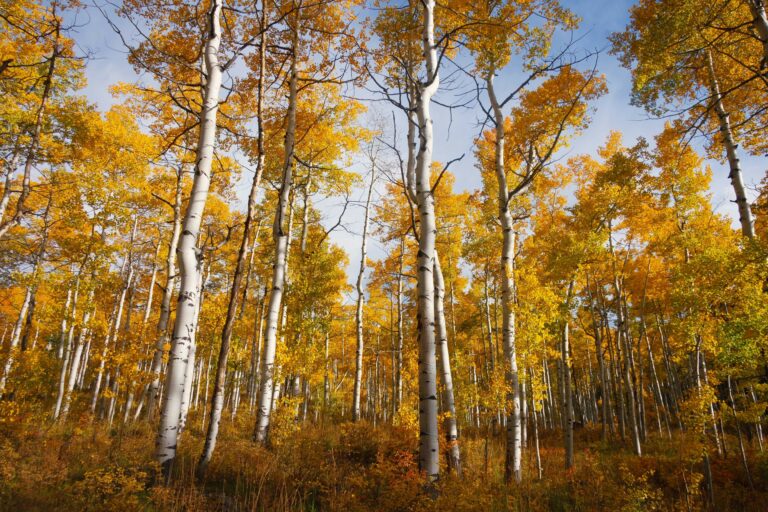
An Aspen forest. Photo by John Price on Unsplash.
Now, imagine that you find such a forest on a planet without a host star (a planet that has no light!). Such a forest is nothing like our earthly trees: it has a different chemistry, different size, different shapes, different biology, different ecology. The only thing that such a forest has in common with our earthly forests is the fact that its trees branch out from the ground in a way that resembles how our trees branch out. Such a forest is a Trilak.
Because the analogy is helpful to visualize a Trilak, we can use the word trilak-forest as a synonym of Trilak body, and we can use the word trilak–tree to designate each of the physical components of the Trilak.
Here is where things get interesting: a trilak-tree is the equivalent of a sentence. Each of the trees in the forest is an utterance. Speaking is a synonym of growing. A Trilak body is, quite literally, made of language.
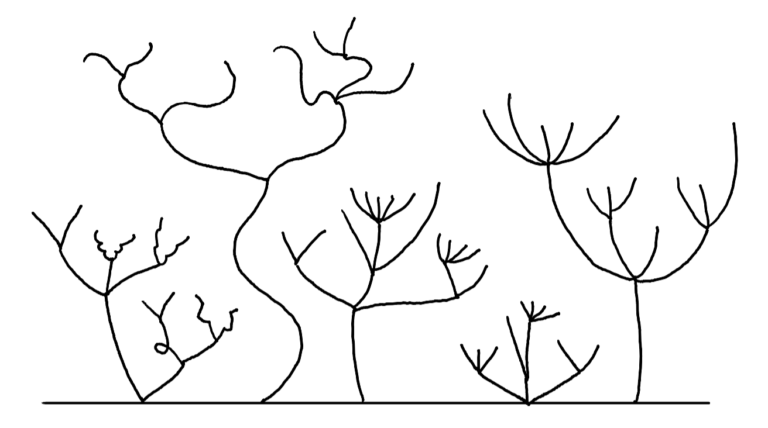
Schematic and oversimplified representation of a Trilak composed of six trilak-trees which could correspond to six sentences. This representation does not mean/translate to anything—at least not yet—, I draw it only to provide a first visual idea of what I mean by Trilak.
A good portion of this grammar aims to explain how trilak-trees are analogous to sentences. I need to make two clarifications before going forward:
- Trilak-trees are only analogous to sentences. I am not claiming that they are sentences. However, they correspond to sentences structurally because they express events at this level. If we needed to translate a sentence from a human language to Trilakese—a task that could be achievable only to some degree—, it would most likely require a single trilak-tree.
- The analogy between a sentence and a trilak-tree is not that of a syntactic tree. In linguistics, it is a common and useful practice to represent the structure of sentences from spoken languages using tree structures (see image below). However, the structure of trilak-trees has no parallel with syntactic trees.
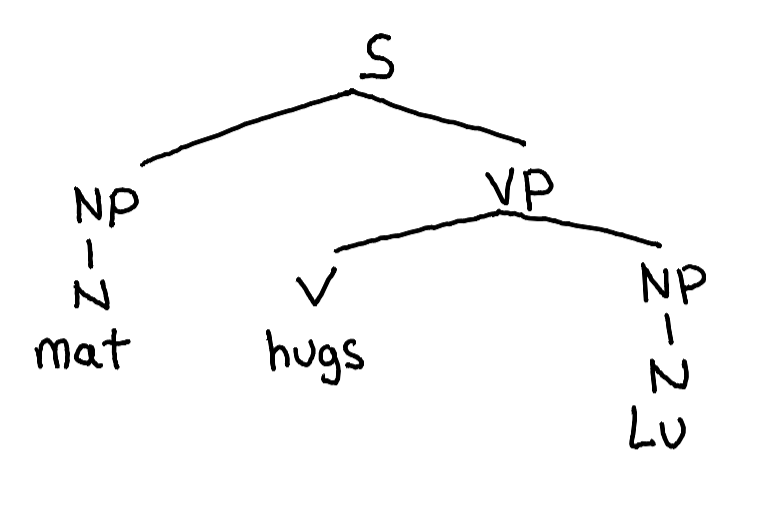
A syntactic tree representing the structure of the sentence Mat hugs Lu. A Trilak is not a syntactic tree.
So, in summary, a Trilak is an alien whose body is a forest of trilak-trees, each of which is analogous to a sentence.
But wait, there is more! You may have noticed I said that a trilak-forest corresponds to its body. Trilaks, however, are more than their bodies. There is a sort of psychological aspect to these aliens which surfaces in the way that each Trilak speaks. This means that a Trilak is not only the group of trilak-trees that conform its body but the way in which it grows: the choices it makes when it speaks are also a fundamental part of what a Trilak is.
You may have a few questions in mind. I don’t blame you. How do Trilaks speak? How exactly do they listen to each other? What do they speak about? Do Trilaks share space? Do they think? What is the purpose of Trilakese? Bear with me; I promise I have answers.