Think about the last time you used the word normal. Did you use it to describe someone? An event? A place? An object? What did you mean when you used it? Say, for instance, your friend is describing their last date to you: “She has brown eyes, a glamorous style, and normal hair.” What did your friend mean by normal hair? Were they pointing out a statistical fact of their community, commenting on the ordinariness of their date’s hair, or implying that some hairs are normal and others are not? You may see how claiming that someone’s hair is normal can be problematic, and if you don’t see it, change hair for skin color.
Why am I about to discuss the meaning of the word normal in a blog about alien communication? Because how we think of aliens is closely tied to what we consider normal. If we met an alien tomorrow, what kind of alien would it need to be to be considered a normal alien? Would it even make sense to describe an alien as normal?
The two senses of normal
The interesting and problematic thing about the adjective normal is that it has two senses that are quite distinct but often fit in the same contexts. The first sense is what I will call statistically normal and it is used to describe things that are regular, frequent… the statistical norm. The online Oxford English Dictionary (OED) offers one definition for my statistically normal:
“Constituting or conforming to a type or standard; regular, usual, typical; ordinary, conventional. (The usual sense.)”
For example, if you tell your friend that you had a normal day, you are most likely meaning that your day was like most of your days are. If you plotted a graph of how good or bad your days are, you probably end up plotting a normal distribution, and your normal day is somewhere close to the peak.
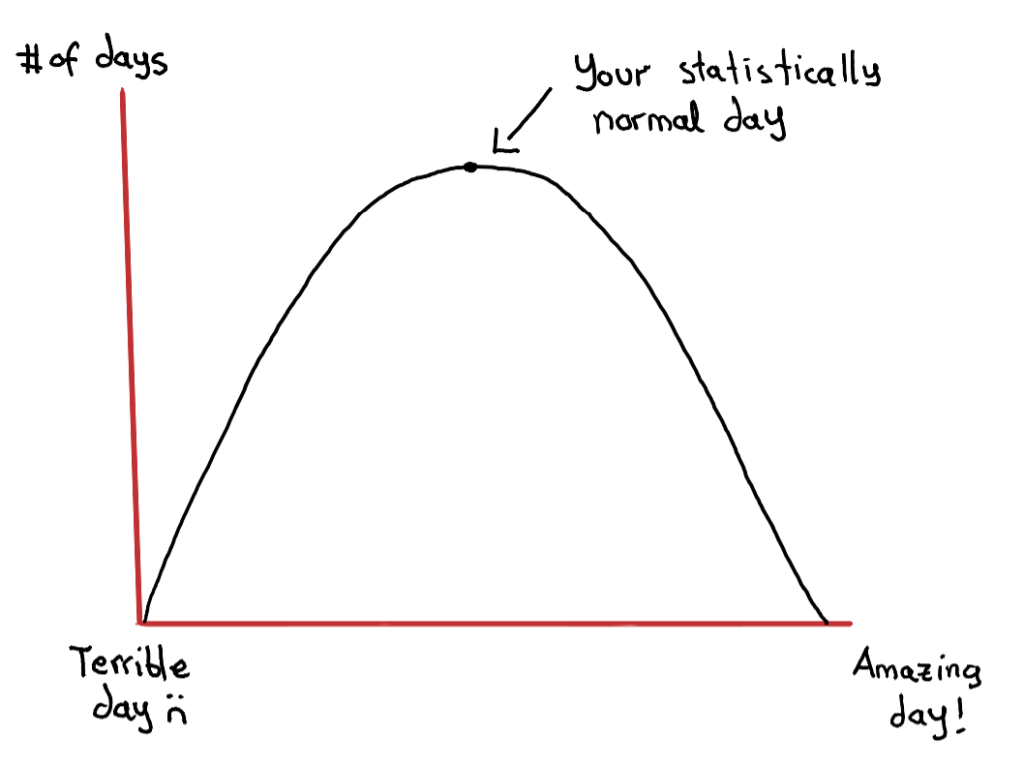
Importantly, the regularity behind statistically normal things can be incidental as when we talk about facts of nature (e.g., “It is normal that the sun rises every day”), but it can also be prescribed as in the case of norms or conventions (e.g., “It is the normal spelling of the word.”). This ambiguity of intention (whether something is normal because it is part of nature, or whether it is normal because it obeys a human-made rule) will become relevant in a second.
The second sense is what I will call the soundly normal. This is the sense that we use to describe things that we consider acceptable based on our knowledge and/or our ideology. It is used, for example, to describe things pertaining to health (e.g., ‘normal blood pressure’). The online OED offers the following definition:
“Of a person: physically and mentally sound; free from any disorder; healthy.”
I argue that people use soundly normal in a broader way than this definition, not limited to people but extending to any noun. For instance, you can use it to describe objects as in ‘It is a normal pencil,’ not to emphasize that your pencil is within the statistical norm (maybe it is a weird-looking pencil), but to point out that it deserves to be called a pencil because it is functional, it is free of defect, it is a sound pencil! A closer dictionary definition to my soundly normal is Merriam-Webster’s “not exhibiting defect or irregularity,” but I still like to include OED’s to illustrate how soundly normal changes depending on the noun it describes.
The soundly normal has a layer of judgement attached to it: something soundly normal is good, it is sane, it should not be judged as bad. Unlike statistically normal, which tends to be more objective (you can, in principle, count the frequency of things), soundly normal tends to be more subjective (people disagree more often on what is acceptable or not). For example, it is hard to deny the statistically normal of artificial intelligence (AI) on the internet, but people often debate on how soundly normal AI use is.
Statistically and soundly go hand by hand
Now that we have a shared understanding of statistically and soundly normal, we can appreciate how they relate to each other. One important way the two senses are tied is by the mere-exposure effect: a widely studied phenomenon by which you are more likely to like things you are more exposed to. Whatever you experience more often feels more familiar to you, and things that feel familiar often feel more acceptable (this is called a familiarity heuristic). In other words, if something is statistically normal you are more likely to consider it soundly normal as well. This, of course, is not a rule; the fact that people die in car accidents every day does not mean that we describe car accidents as soundly normal, but it does partly explain why people tend to desensitize to tragic events that are statistically normal (the more you hear bad news, the less your emotional response tends to be, and the more likely you are to speak of them as just statistics). It is also important to clarify that something does not have to be a true statistically normal to feel like one. The frequency you think something has is sometimes more important than the frequency it actually has. What you consider statistically normal is, more often than not, what you assume to be more frequent and, because our beliefs and experiences can bias our expectations, we may describe as statistically normal many things that are actually not as frequent as we believe. For instance, if your circle of friends likes a certain singer, you may feel tempted to infer that everyone likes that singer, even if most people don’t (you simply don’t talk about music taste with other people).
Statistically normal influences soundly normal via the mere-exposure effect, but soundly normal can also influence statistically normal because we want things that we consider acceptable to be more frequent. Here is where the ambiguity of intention of statistically normal plays such a crucial role: we can prescribe something via a rule, social norm, convention, etc., to attempt to make it a statistical norm. Notice the subtlety: soundly normal tends to be more subjective, but if you manage to make it statistically normal you can more easily claim objectivity and reinforce the soundly normal via the familiarity heuristic. Take a second to appreciate how powerful that is.
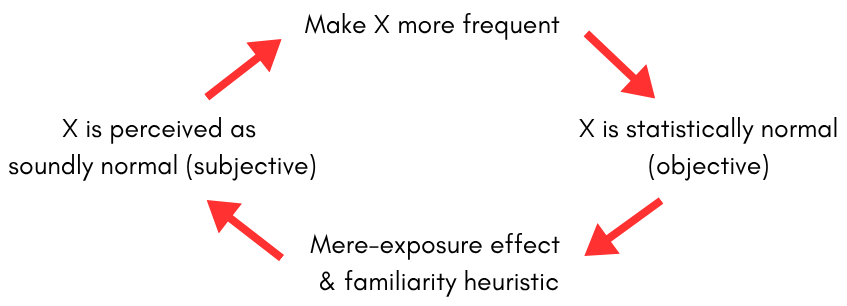
I think the power of the normality feedback loop can be used for good things. For example, plug ‘Getting vaccines’ on the X in the loop. If we lived in a community where vaccines are not used (but diseases that could be prevented by vaccination exist), saying ‘vaccines are normal’ is using the soundly sense. Suppose you are a doctor and make a campaign to convince people in this hypothetical community that vaccines are normal. What you are attempting is shifting the sense of the word from soundly to statistically. If you succeed, people will agree with you and they will vaccinate, making ‘vaccines are normal’ a statistically sense. Once vaccines are statistically normal, people will be more likely to vaccinate because vaccination will feel more familiar, and hence more acceptable.
Unfortunately, powerful things can be used for evil too (and even more unfortunately, we know many devastating examples from our history). Many people use the statistically normal to justify discrimination against minorities; their logic goes the following way: if something is not statistically normal(a minority) it must be the case that it is not soundly normal. The assumption underlying this reasoning is that whatever is perceived as more common is better, an assumption that happens to be false.1 Ableists—people who discriminate against people with disabilities—would say that a disabled person is not normal by pointing out that it is not normal to, for instance, miss a leg. But these are two drastically different claims: missing a leg is not statistically normal and is not soundly normal (unless it does not affect in a negative way the life of the person, in which case I am unsure whether they would consider it a disability); however, claiming that a disabled person is not soundly normal is a claim on their status as a person, not on their disability: it is implying that their humanity is not acceptable. Such implications are dangerous to society because they form the basis of hateful ideologies. This example illustrates how people can move from one sense of the word normal to the other in subtle ways to justify any kind of discrimination.
Another example of how the two senses of the word normal can be used for good or evil is that of companies that spend a lot of money to get some (good or bad) product in your head through advertising. Their whole purpose is to make you comfortable around their product so that you blindly accept the fallacy that ‘whatever is common is automatically more acceptable’ by reframing it as seemingly evident: ‘whatever is (statistically) normal is (soundly) normal.’
A normal alien representation
Now that we are aware of the complicated use of normal, we can discuss whether alien representations (AR) are normal. Notice I am talking about representations rather than actual aliens because I care about how we think of aliens (particularly their communication, see next section); not so much about aliens’ existence.
An AR can be statistically normal in at least two ways: it is normal with respect to humans or with respect to other ARs. First, the more an AR is familiar to humans, the more statistically normal it is. Because humanoid aliens have been a favored representation in popular science fiction, they are statistically normal representations. An example of an statistically abnormal representation is that offered in the movie Arrival (2016), where aliens look and behave more like cephalopods. Second, within the same narrative some aliens could be more common than others; for instance, in the Star Wars universe, aliens like Yoda are very rare while wookies like Chewbacca are statistically normal.
What counts as a soundly normal AR is a very interesting debate. If I were to make a survey, my guess—informed by my discussion of the mere-exposure effect— is that most people would consider an AR more soundly normal if it resembles the statistically normal AR. This is, if I show a picture of a humanoid green creature with antennae you would be more likely to judge this representation as more acceptable of an alien that if I showed you a picture of a circle with a cloud of dots inside that I claim to be extraterrestrial and alive (and maybe just a few micrometers big). The green humanoid with antennae would be, for most, a more normal alien. However, I also guess that if I changed the question to ‘Which of the following representations do you think is more likely to be an alien that humanity could encounter on another planet?’ and showed people the same two representations, more people would choose the circle with a cloud of dots (accepting that it is extraterrestrial and alive) than the green humanoid with antennae.
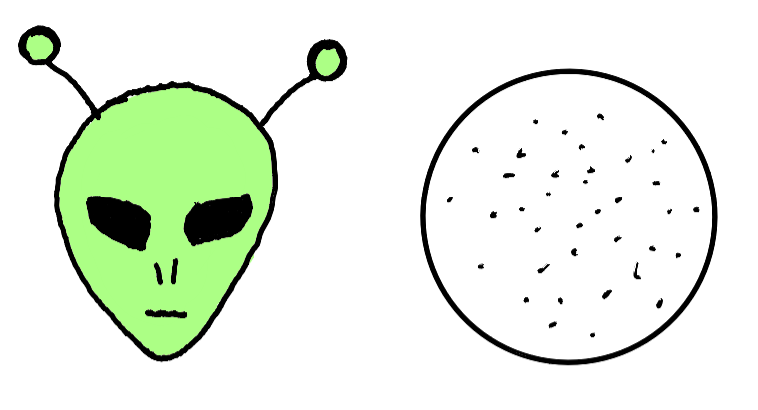
Maybe I am totally wrong about this prediction, but it seems intuitive to me that most people would judge something that does not look human to be a more realistic representation of an alien because their own intuition tells them that if aliens exist, they more likely don’t resemble us.2 In other words, we seem to have the intuition that the more (statistically and soundly) abnormal something is on Earth, the more it belongs to another place in the universe. If this is the case, I find it fascinating that our soundly normal ARs do not match our soundly normal intuition of what aliens could be. Maybe this could just be a reflection of a more recent trend towards less-human ARs clashing with a tradition of humanoid aliens, and maybe this trend is motivated by people finding humanoid representations less convincing from a scientific and statistical standpoint3 (although this certainly would not explain how many alternative ARs are more scientifically-accurate).
A normal alien language representation
While I don’t like the term alien language (as I discuss here), basically anyone who has ever explored the theme of alien communication has focused their exploration around this term, so it’s worth wondering: what is a normal alien language?
Since personified alien languages are the most common in the genre, they are statistically normal and, by means of the familiarity heuristic, they are the most likely to be judged as soundly normal. Based on this reasoning, if I wanted to design an alien language for my next science-fiction best-seller I should make a spoken language that resembles a human language but has some silly ‘alien’ twists like funny noises, an atypical word structure, or absurdly long compound words. Such a language would be considered normal as an alien language. It would also be a safer choice if I don’t want to distract my reader with linguistic matters while providing them with an acceptable portrayal.
However, if I want to use more creative linguistic freedom… How could my alien language be unique but still acceptable? Our best language acceptability criteria come from natural languages, so we can extend these criteria to alien languages: if we want something to be enough of a language (in the human way) then we follow enough of these criteria, and we break enough of them to add the alien component: the more criteria you break, the more alien. The issue with this method is that there is no clear limit as to how many criteria are enough for the alien language to be acceptable as a language… and, as I have mentioned before, there is no consensus on these criteria. (I discuss this strategy to create an alien language in this post!).
So, the idea that an unacceptable natural language qualifies as a soundly normal alien language works in principle but turns out to be very impractical. This is one of the reasons why I prefer the term alien communication system (ACS)—the advantages will hopefully become clearer in future entries 🙂
A normal conclusion
What we consider normal matters because it biases our judgement and actions (for good or bad). Unlike other biases, the normal bias is reinforced by a powerful feedback loop: frequent things often feel soundly normal and we often want things we judge soundly normal to be more frequent.
In the context of aliens this is interesting since we don’t necessarily want a preferred representation of an alien; what makes aliens interesting is precisely their unfamiliarity. The moment we agree on what kind of unknown is normal, we risk putting an end to our quest for the unknown. If an alien, or alien language, starts feeling too normal, maybe it’s a good idea that someone designs another representation—not to say that the normal alien or language is bad, simply that it shouldn’t be the only one we ever think about!
Importantly, the normal bias plays a central role in many other contexts outside of this blog. As I discussed, it is a powerful tool that can be used to our advantage but, more often than not, it seems to be used to divide and harm people.
So, next time your friend tells you about their date, make sure you are both clear on what normal means.
- Something being common has nothing to do with it being acceptable or good. Plastic is extremely common and is destroying the planet. Some diseases are common and kill thousands. Hate speech is common and it divides and destroys communities. ↩︎
- Unless, of course, you believe in some form of universal evolution in which a humanoid form always arises. ↩︎
- From a scientific standpoint aliens reachable to humanity (in space and time) would more likely be very simple and small life forms like single cells—but that kills all the fun of imagining other possibilities! From a statistical standpoint, the universe is too large to restrict our thought to only humanoid creatures. ↩︎